WS-UIENet: A Wavelet-Decoupled Semantics-Guided Underwater Image Enhancement Network
|
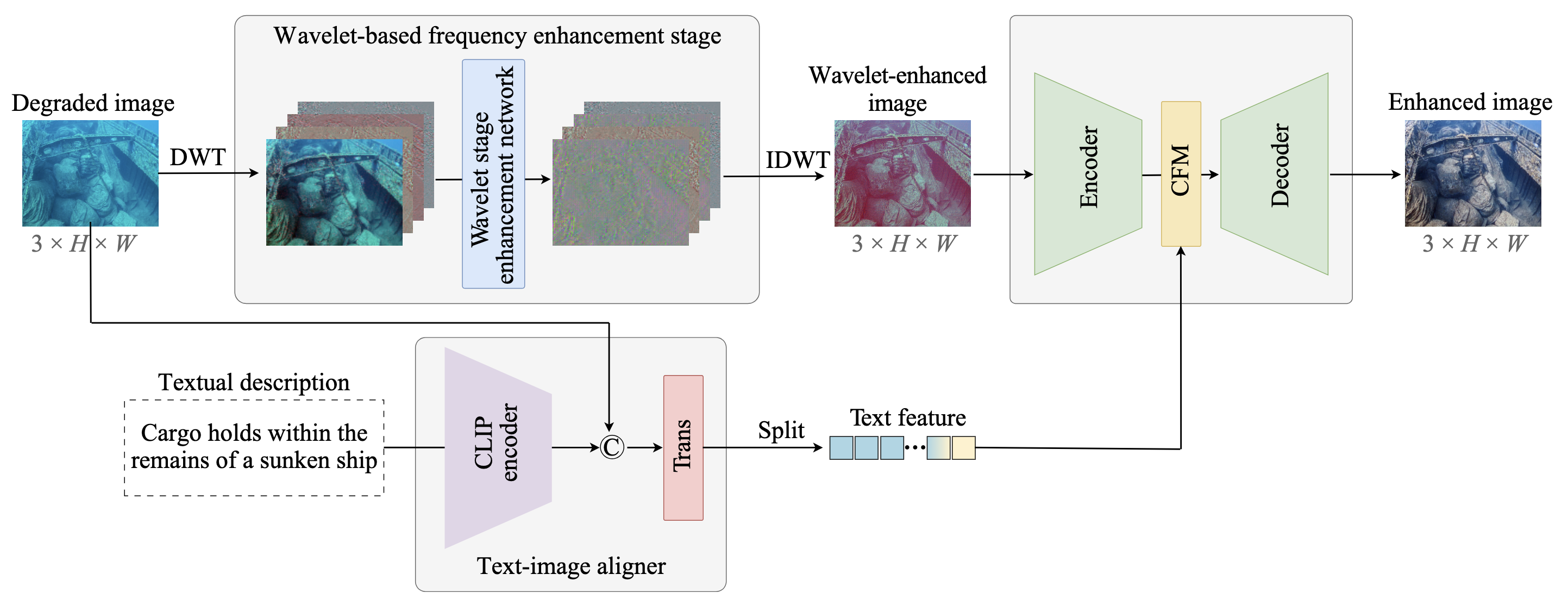
The overall architecture of WS-UIENet consists of two main components: a wavelet-based frequency enhancement stage and a semantic-guided spatial refinement stage.
Abstract
Underwater images often suffer from severe degradation caused by wavelength-dependent light absorption and scattering, resulting in color distortion, illumination attenuation, low contrast, and loss of fine structural details.
Existing underwater image enhancement (UIE) approaches have achieved promising progress, yet they still face notable limitations.
Prior-based methods usually depend on restrictive physical assumptions and therefore show limited adaptability to diverse underwater environments, whereas learning-based methods often rely on increasingly complex network architectures, leading to high computational cost and limited practicality in resource-constrained underwater platforms.
To overcome these challenges, we propose a wavelet-decoupled semantic-guided underwater image enhancement network (WS-UIENet), which integrates the wavelet transform with textual semantic guidance.
Specifically, WS-UIENet adopts a two-stage enhancement framework, which comprises a wavelet-based frequency enhancement stage and a semantic-guided spatial refinement stage.
In the frequency enhancement stage, wavelet decomposition is used to separate low-frequency illumination and color degradation from high-frequency texture and structural degradation, enabling targeted restoration of different degradation components while reducing the learning burden of the network.
In the spatial refinement stage, textual semantic features extracted using a vision--language model are injected into the bottleneck layer as conditional modulation signals, providing perceptually meaningful guidance for semantic-consistent enhancement.
To our knowledge, this work is the first to jointly exploit wavelet-based frequency decomposition and textual semantic guidance within a unified framework for efficient UIE.
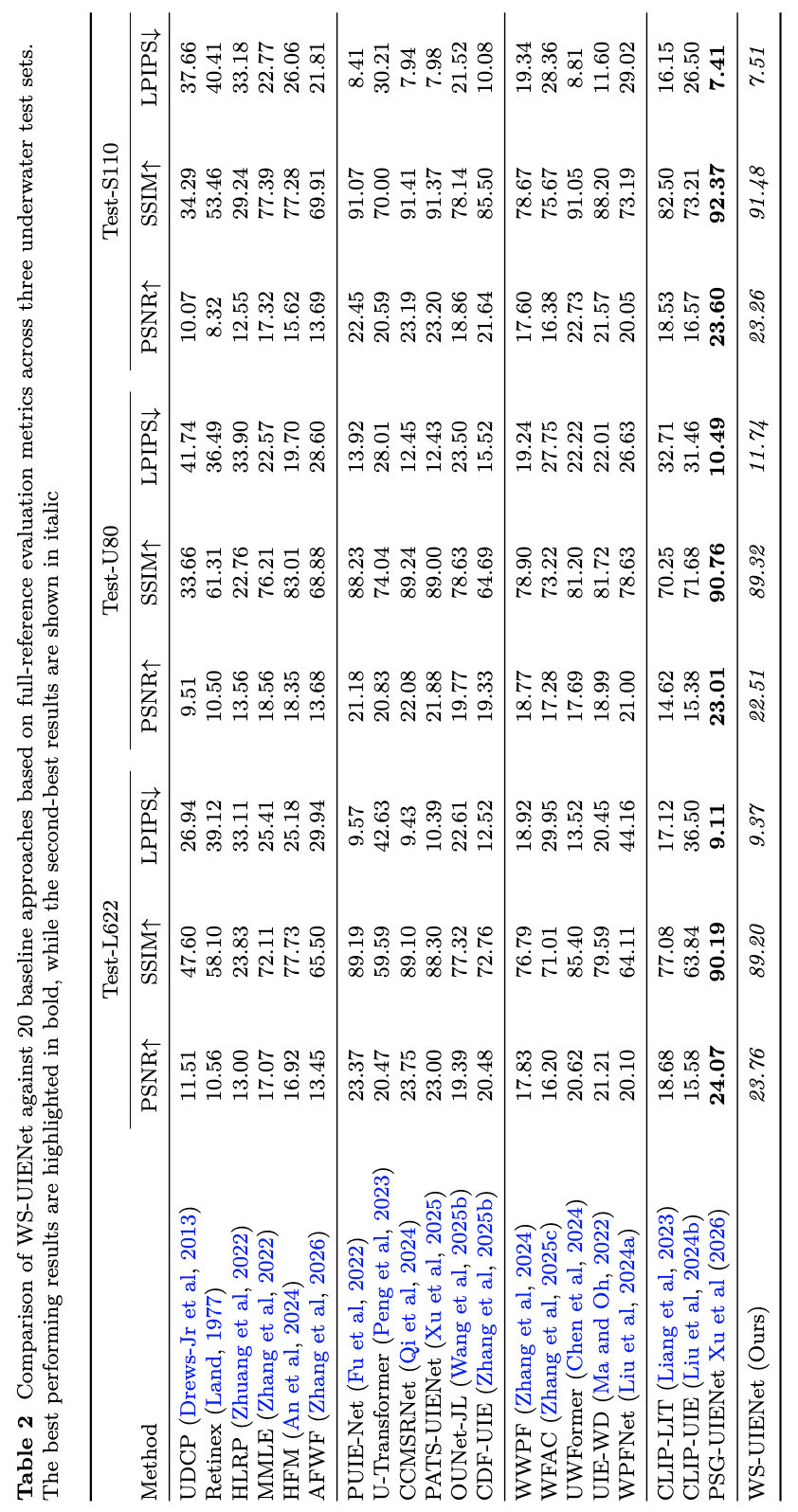
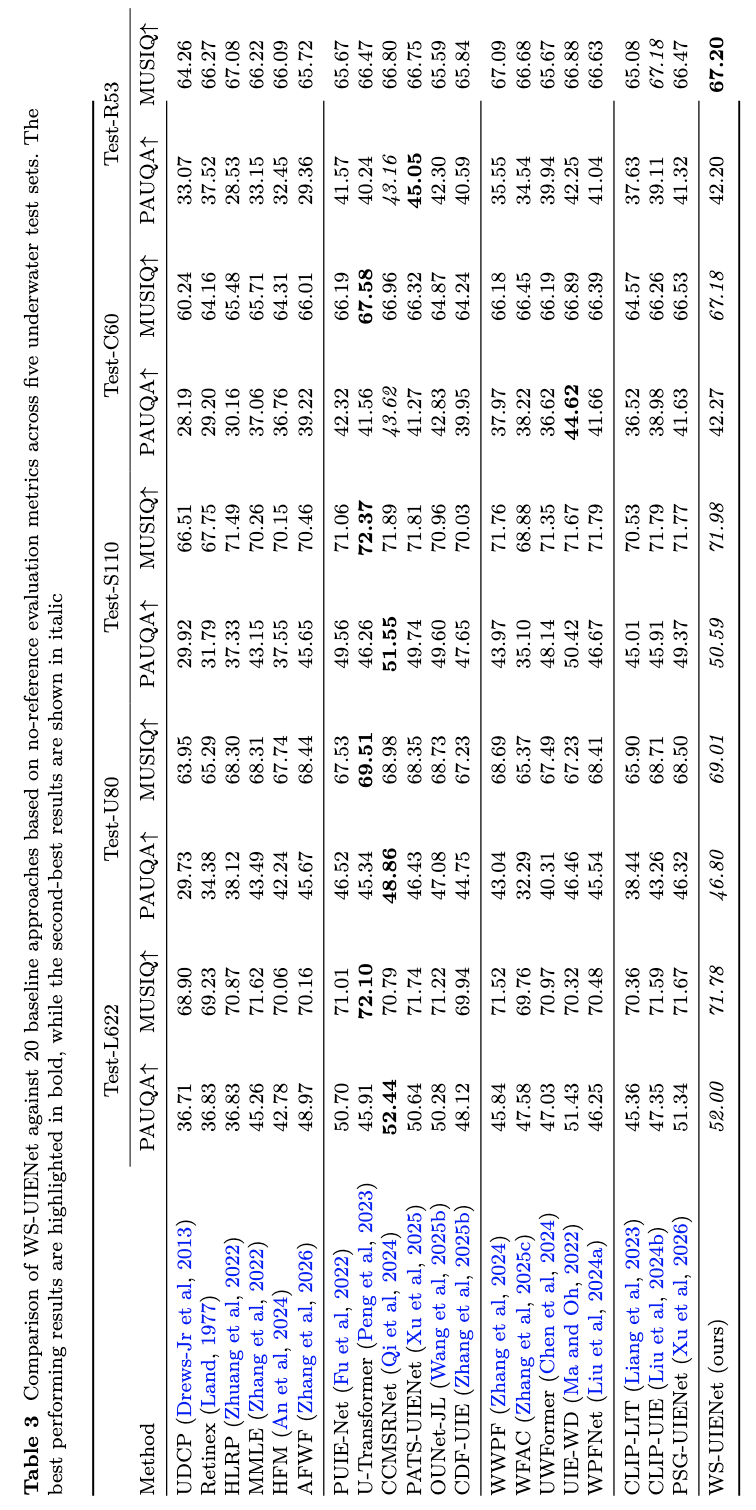
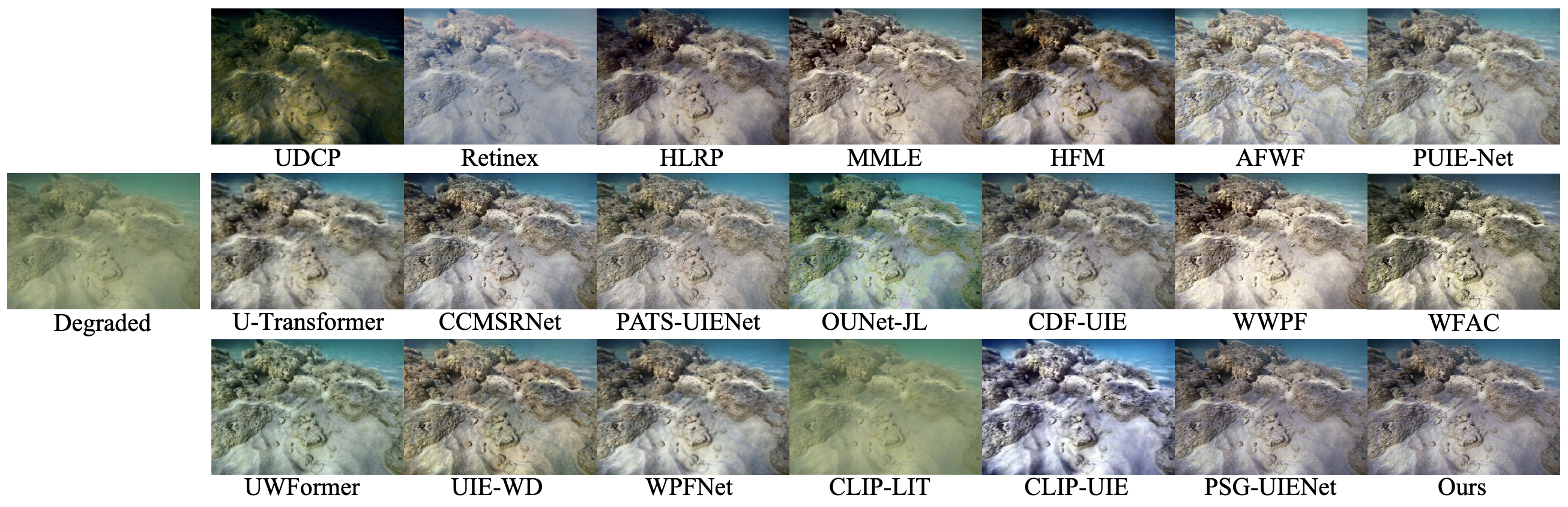
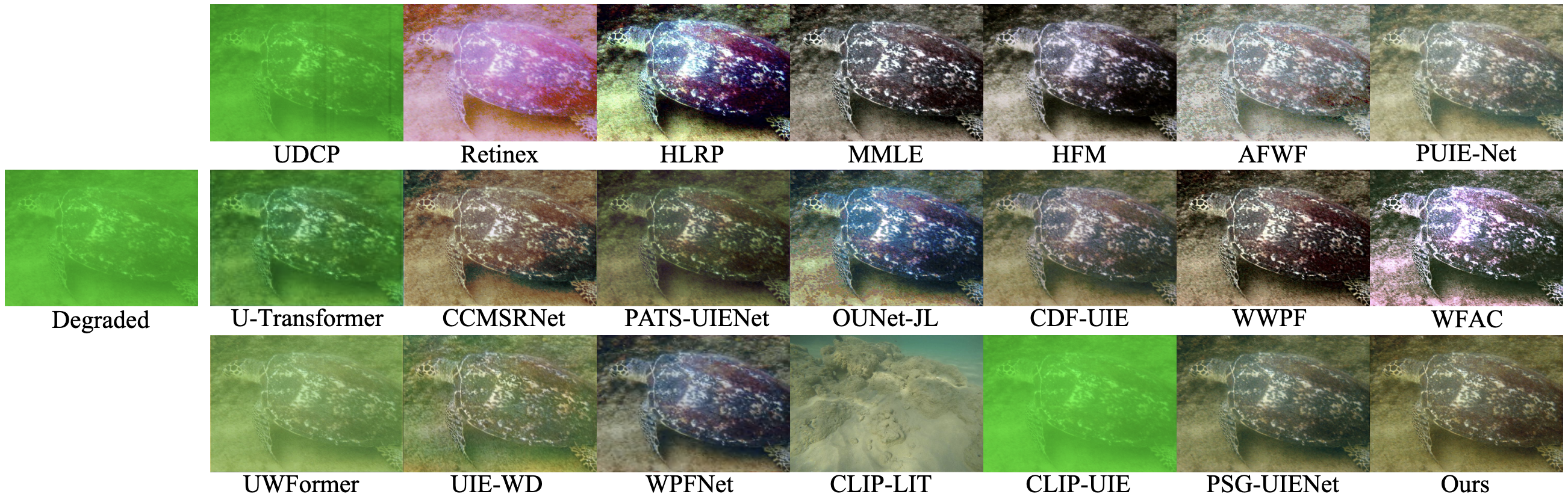
Comprehensive experiments on four real-world underwater datasets demonstrate that the proposed WS-UIENet achieves competitive performance compared with 20 state-of-the-art UIE methods.
In addition, WS-UIENet achieves comparable performance to the strongest text-guided UIE method while nearly halving computational complexity, demonstrating a favorable balance between effectiveness and efficiency.
Links

Wavelet-Based Frequency Enhancement
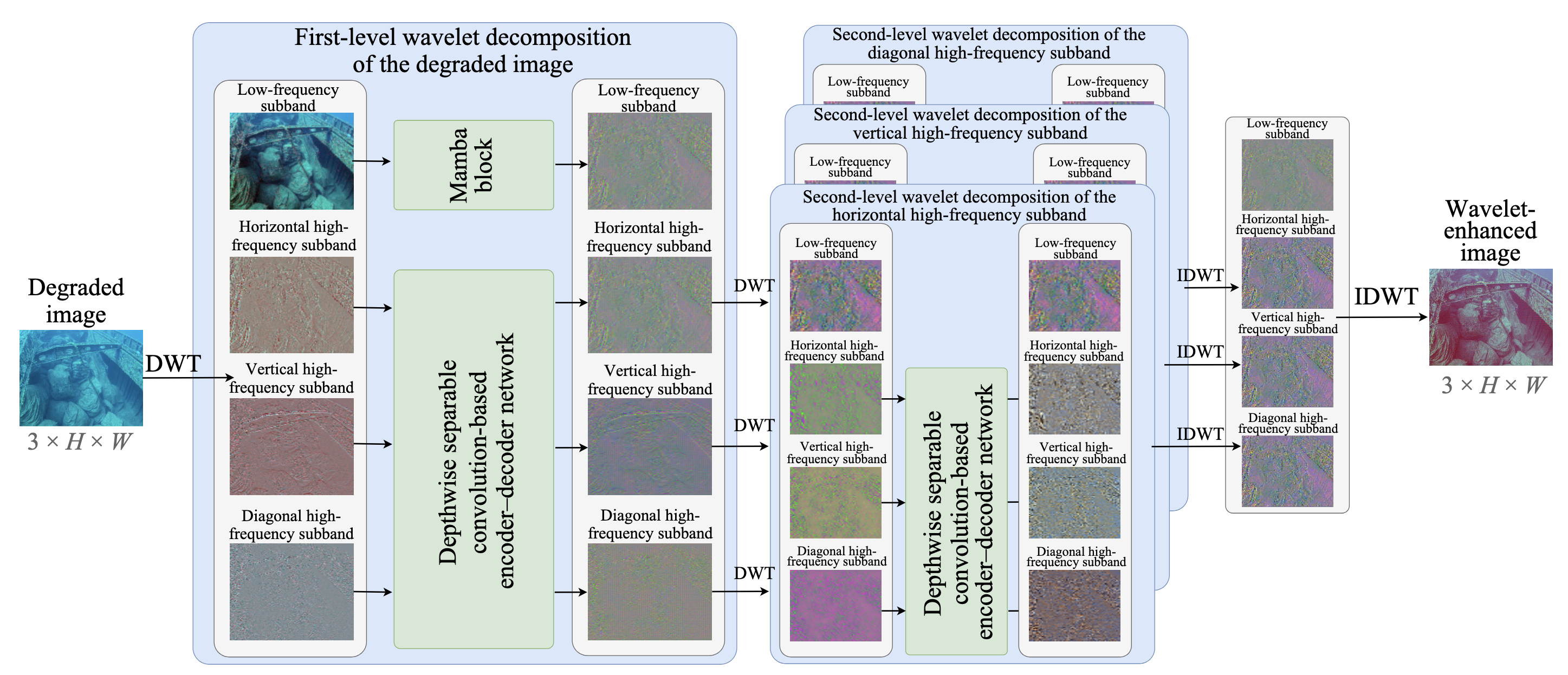
Architecture of the wavelet-based frequency enhancement stage in WS-UIENet.
Semantic-Guided Spatial Refinement
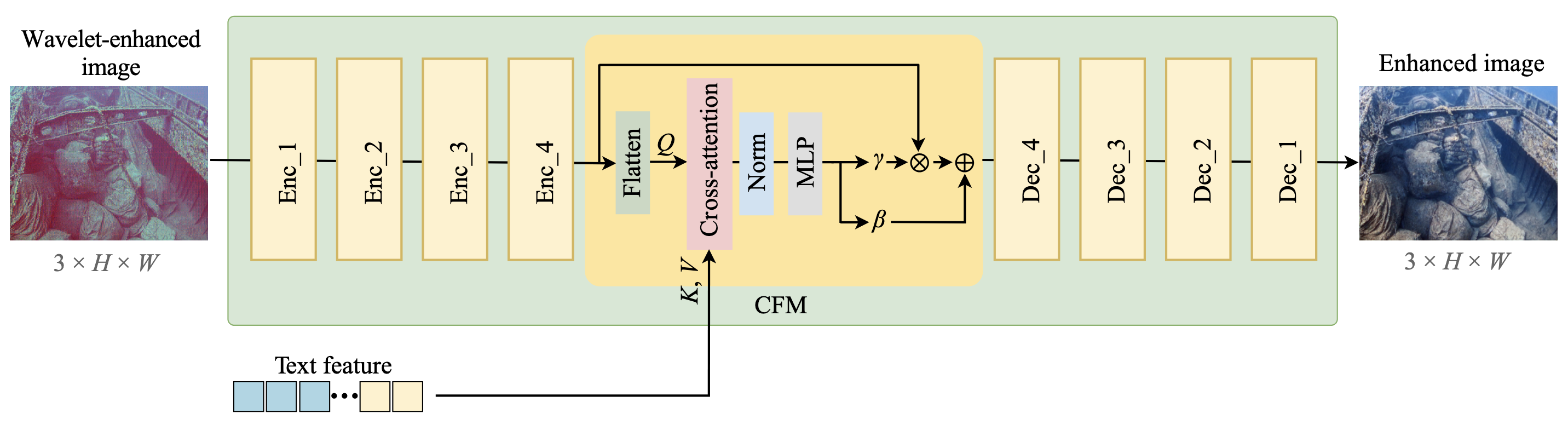
Architecture of the semantic-guided spatial refinement stage in WS-UIENet.
Experimental Results
|
|
Quantitative Results on LUIQD-TD, UIEB, SUIM-E and SQUID data sets.
|
| |
|
| |
|
| |
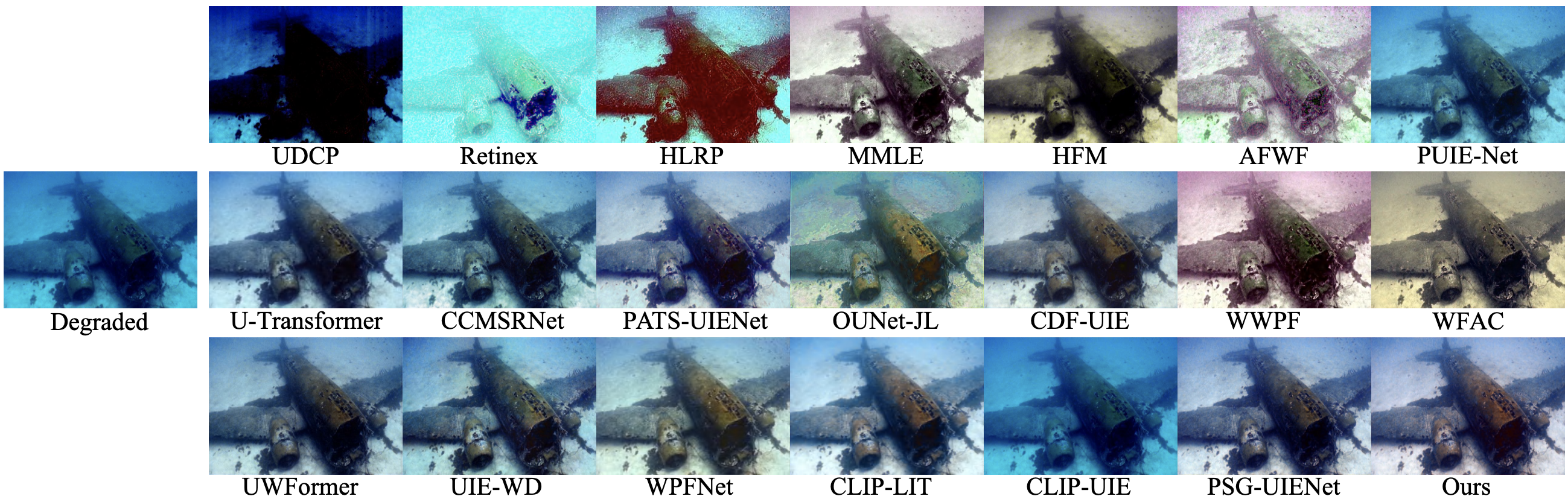
Qualitative Results on Three Real World Underwater Images and A Underwater Image.
Citation
    @ARTICLE{

    }